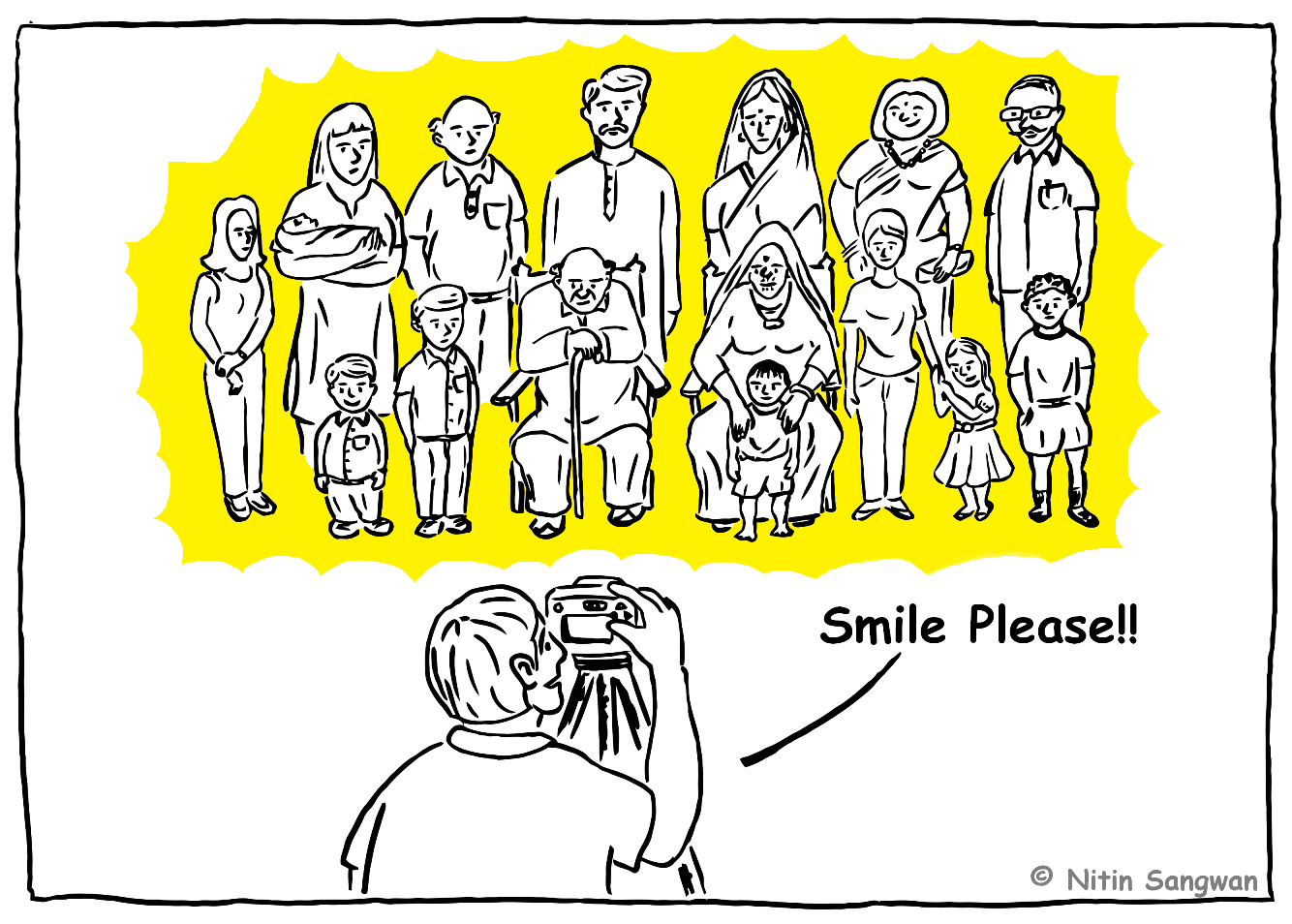
Joint family is an amazing place to live. Old timers see it as an idyllic place which is the cradle of social learning and emotional bonding. For kids it is a haven of fun with unlimited supply of love and care. Working spouses find a solace here as kids are taken care of by the elderly members. Elderly people in turn find meaning to their lives as they turn children again with the new members of the family. Away from this rosy picture, many feminists see the joint family as a noose around the freedom of the womenfolk of the house. In a patriarchal society like India, the burden of joint family falls unequally on the members of the family. Women are made to make compulsory sacrifices for the family. While every member strives for freedom and individuality, joint family sometimes imposes collective will on them. It creates conflict as well and joint family becomes a liability. Apart from economic causes, relationship management is a big challenge in maintaining the cohesiveness of a joint family or even a nuclear family for that matter.
Tuesday, July 12, 2016
Tuesday, July 5, 2016
THE INDIAN MIDDLE CLASS FAMILY
'Middle Class' is an interesting word. People belonging to this stratum of society are so heterogeneous that many would even agree that they don't even belong to single class. A bureaucrat, a skilled workman, an entrepreneur, an emerging artist, a doctor and so on, each one of them claim to belong the ubiquitous middle class family. To reposition these heterogeneous members, concepts like 'upper' and 'lower' middle class were also introduced, but they are also equally volatile as the concept middle class itself. Some project middle class as the torchbearer of social innovations and change, while others blame it as an inward looking group always preoccupied with its own trifling issues. Demographers see a burgeoning middle class as potential future labor force, while the industry looks upon it as a profitable consumer base. Middle class imagination is far more diverse today than it was a couple of decades back when a typical family with a scooter was a poster child of the Indian middle class.
Sunday, July 3, 2016
LAND and DEVELOPMENT CONUNDRUM
Development is a relatively
simple sounding word, but is very difficult to define. Fallout of past
developmental models have shown that how wrong we have been in the understanding
of this word. However, whatever be the definition, it entails one irreplaceable
ingredient – land. From housing to infrastructure, from schools to research
parks, everything needs land. In India, land is not only an economic entity,
but also has cultural and social significance attached to it. For a significant
chunk of population, it is the only means of livelihood. However, historically
the process of land acquisition process has been carried out in a sub-optimal
manner. The benefits which accrued from the land were shared in an inequitable
manner with the original right holders. Worst sufferers of this process were
those like tribal people of India who had the least capacity to raise their
voices. This further skewed the socio-economic scenario, especially in the
context of rural-urban development. The new Land Acquisition Act of 2013 is a
right step to correct some of the defects of the earlier legislation, but still
a lot more needs to be done.
Thursday, June 30, 2016
DEMOGRAPHIC DIVIDEND DILEMMA
Demographic dividend is often cited
as a panacea for the over-populated developing countries. It is often assumed
that the population is actually not a burden and the part of the population in
the working age group shall be productive and contribute towards economic
growth. This in turn will have domino effect on all socio-economic
developmental dimensions. Over-enthusiasts often project that a young
population of a billion will translate into a pair of billion working hands. However,
human beings are not machines. A billion young hands are not same as a billion
machines. All humans have different capabilities and sometimes these capabilities
have to be developed also. Education and skill development are two important
aspects of this development process which can transform the potential of
population into real tangible demographic dividend. Without doing so, the
potential demographic dividend may turn out to be a demographic burden instead as a billion pair of hands also come with a billion mouths to feed.
Behavioral dimension of the population has also become increasingly important.
Punjab is an example. If the behavior of the young population is allowed to go
awry, prospects of demographic dividend dim even further.
Tuesday, March 8, 2016
8th MARCH: FOR THE WOMEN, BY THE WOMEN
Today is International Women’s Day. It celebrates the
centuries old struggle of women for equality. Contemporary international women’s
movements date back to beginning of 20th century when early rights
such as equal adult suffrage and other civil rights were demanded by women. In
India also this period witnessed the growth of many women’s organizations such
as ‘All-India
Women’s Conference’, ‘Women’s India Association’ etc. They had a
pan-Indian appeal. Later in 1970s, the women’s movement resurfaced with
newer liberal issues. Many victories were scored by these in India and abroad,
but many battles are still to be won. In India, workforce participation of
women is mere 18%. Their representation in 16th Lok Sabha is just 61
(out of 545 odd members) i.e. barely 12% – and that’s the all time high figure! Violence
against women is still unabated despite plethora of legislation. This cannot
change unless we remove our cultural glasses which see woman as inferior
species. And to do that time is now. It is a good sign that, the day before
President of India expressed concern over delay of Women’s Reservation in
Legislatures Bill and today Government of India announced a belated entry of women
into fighter pilot roles.
Wednesday, March 2, 2016
FOOD or FREEDOM?
Recently a company announced a smartphone at a price of a simcard. After initial jubilation, all sorts of speculations and allegations started flowing thick and fast. As a result, the company was forced to announce the return of the money and declare that it will now deliver phones on cash-on-delivery basis. Imagine this situation in a country where having a smartphone is the last priority for 50 million households. 300 million people can't read the messages in that smartphone given the absence of basic literacy skills. Leave alone e-literacy skills. In broadband penetration, we fare worse than Bhutan and hence the phone will be like a dud piece of electronics for rural folks. NFHS4's recent data shows stunting among children is still at alarming levels. Information and communication are tools of empowerment, but they cannot substitute for the basic needs especially food for a hungry population. A 3G phone cannot address the core 1G developmental issues that we still face. That requires adequate public investment, job creation and minimum social security to all, not a dubious marketing gimmick.
Sunday, June 7, 2015
KILLER TASTE
Various state FDA reports on Janata's favorite instant noodles have created furore. Saans lena to Mushkil ho hi rakha tha, ab khaana bhi mushkil ho gaya. Things turned as ugly as they can. Maggi failed on multiple counts of food standards. And as the closet started to unreveal itself, there were more skeletons as well. It transpired that Nestle has brought into market a product (Maggi Oat Noodles), for which approval was still pending. This revelation put Nestle in a tight spot and even the jet-setting CEO has to concede to the failings of the FMCG giant. Whatever may be the final results after due inquiry, there are certain things which the incident exposed. First, it laid bare the ethical charade of MNCs like Nestle. It was highly unethical on its part to not declare presence of MSG in its product. Just by using clever wordings ('No Added MSG'), it cannot shy away from the onus of responsibility. Following the rules is one thing, following their spirit is the another. Nestle failed miserably on the latter part. Secondly, presence of alarming levels of lead shows that its quality checks have failed to live up the expected standards which are associated with a so called MNC. People in this country might be poor, but their lives are not cheap. Finally, the incident is also a wake up call that not only air, but our water and soils also need a reality check.
Monday, January 26, 2015
RIP R K
The doyen of Indian cartooning R K Laxman is no more and the most important chapter of history of cartooning in India comes to an end. He passed away on 26th January 2015 at the age of 94. He was arguably the longest serving cartoonist of India. He drew more than 30,000 cartoons over a period of around 60 years. He was the only cartoonist who had witnessed all the transition phases of India - from colonial rule to the era of independence, from period of planned social economy to a post-1991 liberalized India. His characteristic strokes made the politicians and other prominent public figures to yearn for more without any heartburn. His political cartoons inspired many generation of cartoonists for their simplicity of figures and sharpness of wit. He started his career as a freelance cartoonist and later worked as a full time cartoonist for the first time with The Free Press Journal in Mumbai where Bal Thackeray also worked along with him. He also illustrated the stories and novels of his prodigal brother R K Narayan. However, the turning point of his career was joining of Times of India where he drew the legendary 'Common Man' from Nehru era to Rahul era in his 'You Said It' column. The gratified nation acknowledged his contribution by conferring Padma Vibhushan in 2005 and Times of India acknowledged his contribution by making him the lifetime employee. Though R K Laxman is no more among us, his strokes are immortal and they will continue to spread humor and inspire many generations of budding cartoonists like me.
Thursday, January 8, 2015
CRUELITY with CARTOONS
Gruesome attack on Charlie Hebdo yesterday was another blatant example of attempts to stifle the freedom of expression. There can be an endless argument over what are the limits to religious sensitivity, but no religion or god will ever permit murders for violation of those thresholds of religious sensitivity. On the one hand it is argued, that religion provides hope, the extremists are trying to exemplify rather the opposite. No god can be so weak that it need to instill fear among the minds of its children to command respect from them. This misrepresentation of religious tenets must stop for the very survival of the religions which such extremists want to protect. The recent killing reminds me of a dialogue from the movie PK that 'I just lost one of my friends when they tried to protect their god...'. In Charlie Hebdo case, we lost 12 of our friends and perhaps many more may have still to sacrifice their lives before we realize that essence of all religions is in making lives better, and not taking them away.
Wednesday, March 5, 2014
JAAT RESERVATION
Recent announcement of Jaat reservation in OBC by cabinet elicited
varied reactions. Jaats are termed as ‘dominant caste’ in North India by noted
sociologists like M N Srinivas and have assumed position of ‘bullock
capitalists’ in post-green-revolution era. They have, for long, dominated the political
arena in state of Haryana where Jaat reservation movement gained utmost
momentum in recent times. Recent announcement regarding reservation has also
raised some fundamental issues vis-à-vis reservation policy itself. Many have
argued about the very notion of reservation and its efficacy in past 65 years.
Reservation may be a symbolic victory, but its benefits are likely to be reaped
by a small section of the purported beneficiaries. Benefits percolate to the
bottom of pyramid in a community too slowly and it might well be a time to
reflect upon this policy afresh. Some other rational criterion like ‘economic
criteria’ may be pondered upon in a re-engineered model of social empowerment
to implement concept of reservation.
Tuesday, March 4, 2014
LIFE @ HIPA – 2: PROXY WAR in CLASS
There are classes in HIPA from morning to evening on various topics
including revenue laws, social laws, rules and regulations and other
para-administrative issues. Some of the officer trainees (OTs) find college
life hangover too difficult to shed-off and are tempted to bunk classes here
too. However, their attempts are deftly foiled by a vigilant Mr Mohinder
Singhji who been an astute Qanoongo before his retirement and has been given
responsibility of ensuring full attendance in classes. Classroom training is a
great opportunity to assimilate many theoretical aspects of administration as
well as to interact with other fellow trainees who later become lifelong
colleagues in career services. Sometimes training become a bit staid and
proxies and counter-proxy measures act as refreshing ingredients of training
curricula. Punctuality is the greatest asset of an officer and is one of the
crucial factors that makes or breaks the image of an officer. Class-room
training is a great opportunity to imbibe this quality which all of the OTs
will appreciate.
Thursday, February 27, 2014
LIFE @ HIPA - 1: RANA RULES
Haryana Institute of Public Administration or HIPA is the institute for training of Haryana Civil Servants. Preparations for state PCS is also a bit hectic and those who were through HCS exam were drafting plans of making most of the 6 months long HIPA class room training. Enjoying the warmth of quilts in December cold was one of the key items on 'Chilling-out-at-HIPA-plan' of trainee officers. Their worst nightmares came true when they learned that they will have to do compulsory PT @ 6 am in the morning in the biting cold (which was relaxed to 7 am amid heavy protests). PT instructor Mr Rana was formerly at LBSNAA Massouri whom our DG brought to HIPA to make Haryanvi officers look more like 'officers'. Its been almost 2 months in training and everyone now appreciate that physical fitness for an officer is as important as professional competence as it increases efficiency manifolds and imparts smartness in an officer. Given the growing hectic work-culture in government offices and increasing life-style diseases, morning PT can be a good stress buster and a great fitness tool. Inculcating this habit early in career will surely pay huge dividends towards the fag end of the career as well as life.
Wednesday, February 26, 2014
AGONY of A CS ASPIRANT
Civil Services Examination (CSE) conducted by UPSC is gateway to the elite government services in India. Three years back, UPSC introduced comprehensive changes in the scheme of CSE preliminary examination. Many students demanded that since changes were comprehensive, they be given relaxation in terms of age and attempts as was done on earlier occasions also. UPSC on the other hand reasoned that 4 attempts are more than it would like to allow and various committees had already argued in favor of reducing number of attempts and age limit. Unlike other entrance examinations, CSE follows a painfully protracted process and traps the aspirants into a vicious cycle of preparation which ends only after 4 grueling attempts are exhausted and 5 precious years of life are gone. Worse, as the age of the aspirant ripens, the unsuccessful aspirant finds himself or herself in a pitiable position where other career prospects also become bleak. On the other hand, given the growing loss of moral values in civil services, UPSC might be rightly thinking of promoting younger minds by reducing age limit and number of attempts as young minds are more amenable to be moulded in a desired moral frame. However, it must also be ensured that those coming from rural backgrounds are not put in a disadvantaged position as they are the ones who face an acute awareness deficit in terms of career prospects and tightening the eligibility norms may further handicap their chances.
Subscribe to:
Posts (Atom)


